
Preview
Uniform Title
The Bryant Slides Collection
Photo Description
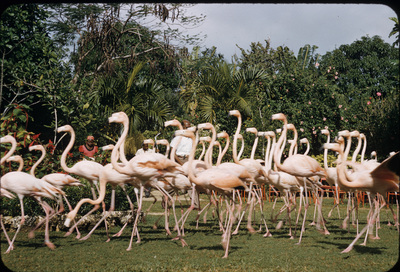
In 1937, Jamaican-born horticulturist Hedley Vivian Edwards opened Ardastra Gardens, now known as Ardastra Gardens, Zoo and Conservation Centre. The word 'Ardastra' is from the Latin Ardua astrum, which means “Striving for the stars.” In 1956, as part of a preservation study to increase their numbers, the West Indian Flamingo was brought to New Providence by the Bahamian government from Great Inagua and housed in Ardastra Gardens. At the completion of the study, some of the young flamingos were given to Edwards. Later, Edwards trained the flamingos to march on command, which for years has been one of the most well-known visitor’s attractions at Ardastra Gardens, Zoo and Conservation Centre. In 1982 the gardens were bought by Norman Solomon and became the first zoo in the Bahamas. In the picture, rows of red chairs can be seen in the background as a flock of flamingos march across the foreground of the image. Hedley Vivian Edwards is among the people who can also been seen in the background.
Keywords
Edwards, Hedley Vivian; New Providence Island (Bahamas); Gardens – Bahamas; Zoos – Bahamas; Greater flamingo (Emblem) -- Bahamas
Format
image/jpeg
Size Original
35 mm
Coverage-Temporal
Bahamas -- North America -- New Providence Island
Identifier
DP0003456
Identifier (Genre)
Transparencies
Rights
All rights to images are held by the respective holding institution. This image is posted publicly for non-profit educational uses, excluding printed publication. For permission to reproduce images and/or for copyright information contact Special Collections and University Archives, University of Central Florida Libraries, (407) 823-2576
Collection
Link to Descriptive Guide
Recommended Citation
"West Indian Flamingos on parade in Ardastra Gardens, New Providence, Bahamas" (1959). British West Indies Bahamas HopeTown Slides. 30.
https://stars.library.ucf.edu/bwi-slides-hopetown/30
Keywords
Edwards, Hedley Vivian; New Providence Island (Bahamas); Gardens – Bahamas; Zoos – Bahamas; Greater flamingo (Emblem) -- Bahamas
Accessibility Statement
This item was created or digitized prior to April 24, 2027, or is a reproduction of legacy media created before that date. It is preserved in its original, unmodified state specifically for research, reference, or historical recordkeeping. In accordance with the ADA Title II Final Rule, the University Libraries provides accessible versions of archival materials upon request. To request an accommodation for this item, please submit an accessibility request form.