
Preview
Uniform Title
The Bryant Slides Collection
Photo Description
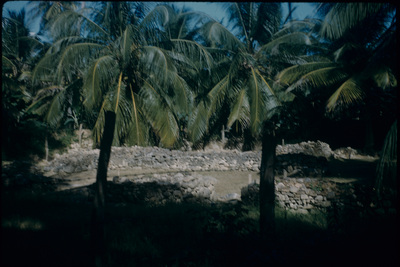
During Christopher Columbus's second voyage to the New World, he landed on the North coast of Jamaica on May 5, 1494 and called the area Santa Gloria. In 1503 during his fourth and final voyage, Columbus and his men were marooned in Jamaica. After his shipwreck, Columbus lived in Maima, a Taino (or Arawaks) Indian settlement near Seville for over a year. The Taino Indians were Jamaica’s first native people. The area is now part of the Maima-Seville Heritage Park, owned and operated by the Jamaica National Heritage Trust. The image shows the remains of walls at an excavation site. Slide labeled Site of Sevilla Nueva.
Keywords
Coconut; Columbus, Christopher; Description and travel; Excavations (Archaeology); Historic sites; Jamaica; Seville (Jamaica); Stone walls; Travel
Subject
Seville (Jamaica) -- Description and travel; Columbus, Christopher -- Travel -- Jamaica – Seville; Historic sites -- Jamaica – Seville; Excavations (Archaeology) -- Jamaica -- Seville -- 1970-1980; Coconut -- Jamaica – Seville; Stone walls -- Jamaica -- Seville -- 1970-1980
Format
image/jpeg
Size Original
35 mm
Identifier
DP0003467
Identifier (Genre)
Transparencies
Rights
All rights to images are held by the respective holding institution. This image is posted publicly for non-profit educational uses, excluding printed publication. For permission to reproduce images and/or for copyright information contact Special Collections and University Archives, University of Central Florida Libraries, (407) 823-2576
Recommended Citation
"Remains of walls at excavation site in Maima-Seville Heritage Park, Jamaica" (1972). British West Indies Jamaica Slides. 119.
https://stars.library.ucf.edu/bwi-slides-jamaica/119
Keywords
Coconut; Columbus, Christopher; Description and travel; Excavations (Archaeology); Historic sites; Jamaica; Seville (Jamaica); Stone walls; Travel
Accessibility Statement
This item was created or digitized prior to April 24, 2027, or is a reproduction of legacy media created before that date. It is preserved in its original, unmodified state specifically for research, reference, or historical recordkeeping. In accordance with the ADA Title II Final Rule, the University Libraries provides accessible versions of archival materials upon request. To request an accommodation for this item, please submit an accessibility request form.