

High Impact Practices Student Showcase Fall 2026
Files
Course Code
STA
Course Number
4164
Faculty/Instructor
Nathaniel Simone
Faculty/Instructor Email
Abstract, Summary, or Creative Statement
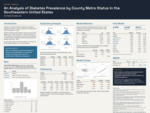
Diabetes prevalence varies widely across different geographical regions, but which health differences this variation tracks are poorly understood. Using county-level measurements from the CDC's PLACES dataset, we investigate whether blood pressure, obesity, and cholesterol levels are sufficient to explain urban-rural variations in diabetes prevalence in the Southeastern United States, defined here as Alabama, Mississippi, Georgia, South Carolina, and Florida. We build a multiple linear regression model using stepwise selection and conduct an ANOVA test comparing models with and without county urbanization level. Both analyses confirm that blood pressure, obesity, and cholesterol levels are not sufficient to explain county-level variation: urbanization level remains predictively useful, suggesting that other health metrics may help to explain the remaining variation. This is a fruitful area for further research.
Keywords
diabetes; multiple regression; southeast counties; health; statistics; urban; rural
Recommended Citation
Kalola, Om and Jore, Caleb, "An Analysis of Diabetes Prevalence By County Metro Status in the Southeastern United States" (2026). High Impact Practices Student Showcase Fall 2026. 1.
https://stars.library.ucf.edu/hip-2026fall/1
Accessibility Statement
This item was created or digitized prior to April 24, 2027, or is a reproduction of legacy media created before that date. It is preserved in its original, unmodified state specifically for research, reference, or historical recordkeeping. In accordance with the ADA Title II Final Rule, the University Libraries provides accessible versions of archival materials upon request. To request an accommodation for this item, please submit an accessibility request form.