
High Impact Practices Student Showcase Fall 2026
Interpretable Prediction of Insurance Premium Amounts Using Statistical Learning Methods
Files
Download IPP_poster (1).pptx (548 KB)
Course Code
STA
Course Number
4241
Faculty/Instructor
Chudamani Poudyal
Faculty/Instructor Email
Abstract, Summary, or Creative Statement
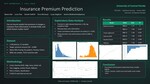
Insurance companies need to charge premiums that are high enough to cover future claims but still fair and competitive for customers. The purpose of our project was to predict an insurance customer’s Premium Amount using information about the policyholder and their policy, such as age, annual income, credit score, health score, previous claims, and policy type. We used a synthetic Kaggle dataset with 1.2 million policies. Our key activities were cleaning the data and handling a large amount of missing values, exploring the data with graphs, and comparing several models, including Multiple Linear Regression, Ridge, Lasso, Random Forest, and LightGBM, using RMSE, R², and RMSLE. We learned two main things. First, tree-based models like Random Forest and LightGBM predicted better than traditional linear regression because they can capture non-linear patterns, and the most important predictors were annual income, credit score, health score, and previous claims. Second, even the best model explained only a small part of the variation in premiums, which showed us that the data matters as much as the model, and that real company data and more validation would be needed before using these models for actual pricing.
Keywords
STA4241; insurance premium prediction
Recommended Citation
Diaz, Lucia; Bai, Bawna; Mukhammedyarova, Sam; Daghum, Lucas; Mccloud, Farrah; and Hedhili Razki, Zaineb, "Interpretable Prediction of Insurance Premium Amounts Using Statistical Learning Methods" (2026). High Impact Practices Student Showcase Fall 2026. 35.
https://stars.library.ucf.edu/hip-2026fall/35
Accessibility Statement
This item was created or digitized prior to April 24, 2027, or is a reproduction of legacy media created before that date. It is preserved in its original, unmodified state specifically for research, reference, or historical recordkeeping. In accordance with the ADA Title II Final Rule, the University Libraries provides accessible versions of archival materials upon request. To request an accommodation for this item, please submit an accessibility request form.