
High Impact Practices Student Showcase Fall 2026
Perceptions of Social Mobility and Attitudes Toward Universal Basic Income
Files
Course Code
SYA
Course Number
4450
Faculty/Instructor
Professor Michael Loree
Faculty/Instructor Email
Abstract, Summary, or Creative Statement
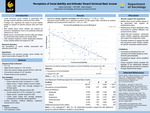
Although upward social mobility in the United States has declined significantly over time, many Americans continue to remain optimistic about their economic prospects. It is possible that this overoptimism may be related to a desire to maintain the status quo and an opposition toward policies that encourage economic redistribution.
The present study explores the potential relationship between respondents' perceptions of social mobility and their attitudes toward universal basic income (UBI) policies. To address this question, 112 UCF students responded to a questionnaire that measured dimensions of perceived social mobility and support for UBI, as well as political affiliation and subjective socioeconomic status. This data was used to calculate a correlation coefficient and build a multiple linear regression model.
The data showed a significant, strong, negative correlation between perceived social mobility and support for UBI. The results also revealed that perceived social mobility could predict support for UBI after accounting for respondent political affiliation and socioeconomic status. The findings suggest that people who believe social mobility is high will tend to endorse lower levels of support for UBI.
Future research should build off of these findings by testing for a causal relationship, or by comparing the strength of the relationship between different groups. The results of these studies could be used to promote the implementation of policies that are consistent with social realities rather than misinformation.
Creative Commons License

This work is licensed under a Creative Commons Attribution 4.0 International License.
Keywords
social mobility; UBI; universal basic income; policy; economic policy; meritocracy
Recommended Citation
Courtright, Casey S., "Perceptions of Social Mobility and Attitudes Toward Universal Basic Income" (2026). High Impact Practices Student Showcase Fall 2026. 56.
https://stars.library.ucf.edu/hip-2026fall/56
Accessibility Statement
This item was created or digitized prior to April 24, 2027, or is a reproduction of legacy media created before that date. It is preserved in its original, unmodified state specifically for research, reference, or historical recordkeeping. In accordance with the ADA Title II Final Rule, the University Libraries provides accessible versions of archival materials upon request. To request an accommodation for this item, please submit an accessibility request form.