

High Impact Practices Student Showcase Spring 2026
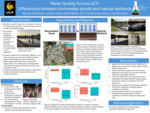
Water Quality Across UCF, Differences Between Constructed, Natural, and Hydrologically Impacted Wetlands
Files
Download Full Text
Download The transcript for the audio in our YouTube video (14 KB)
Course Code
PCB
Course Number
4301
Faculty/Instructor
Dr. Lisa Chambers
Faculty/Instructor Email
lisa.chambers@ucf.edu
Abstract, Summary, or Creative Statement
Wetlands are important as they provide a variety of ecosystem services, including flood protection, habitat, carbon storage, and water quality improvement. Stormwater ponds may perform different functions and have different features than natural wetlands. This study aimed to determine if there are significant differences in dissolved oxygen, pH, conductivity, and temperature between natural wetlands and stormwater ponds. Three natural wetlands and three stormwater ponds were tested across the UCF campus. A YSI and dissolved oxygen probe were used to test three points in each site on March 26 between 7:00pm and 9:00pm. Each parameter, as well as air temperature and the last rainfall event were noted. The mean was calculated for each dissolved oxygen, pH, conductivity, and temperature for natural wetlands and stormwater ponds. The mean for each parameter was higher in the stormwater pond group than in the natural wetland group. ANOVA tests showed no significant differences in pH, conductivity, or temperature between the natural wetland group and stormwater pond group. There was a significant difference in dissolved oxygen between the two groups (p=0.009). This difference in dissolved oxygen levels suggests that manmade systems do differ in the amount of dissolved oxygen in the water. The data suggest that these differences are likely due to differences in organic matter, vegetation, and water level. Overall, differences in dissolved oxygen levels could impact the survival of wildlife in each system
Keywords
Wetlands;Natural;Stormwater Pond;Dissolved Oxygen;pH;Conductivity;Temperature;Campus;Water Quality
Recommended Citation
Medel, Lyndon R. and Hettenbach, Hannah, "Water Quality Across UCF, Differences Between Constructed, Natural, and Hydrologically Impacted Wetlands" (2026). High Impact Practices Student Showcase Spring 2026. 43.
https://stars.library.ucf.edu/hip-2026spring/43
Accessibility Statement
This item was created or digitized prior to April 24, 2026, or is a reproduction of legacy media created before that date. It is preserved in its original, unmodified state specifically for research, reference, or historical recordkeeping. In accordance with the ADA Title II Final Rule, the University Libraries provides accessible versions of archival materials upon request. To request an accommodation for this item, please submit an accessibility request form.