

High Impact Practices Student Showcase Spring 2026
Mapping Intellectual Networks in Texts & Technology: A Gephi Network Analysis
Abstract, Summary, or Creative Statement
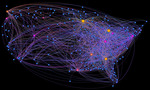
This project employs the network‑analysis platform Gephi to examine the intellectual structure of the Texts and Technology (T&T) PhD program’s core reading list. Our objective was to visualize how thirty‑two foundational texts relate through shared themes, citation practices, and disciplinary affiliations in order to better understand the field’s conceptual foundations. We constructed a multilayered dataset that coded each text for thematic, disciplinary, and author‑citation attributes, and then applied Gephi’s community detection, modularity, and centrality algorithms to identify clusters and structural patterns within the corpus.
The analysis revealed several significant findings. Michel Foucault emerged as the most influential citation hub, referenced by sixteen authors across twenty‑five disciplines, while the broader network organized into two dominant clusters: Technology/Media/Digital Humanities and Critical Race/Gender. Donna Haraway served as a rare point of intersection between these groups, indicating her integrative role across disciplinary boundaries. Equally important, the visualization exposed notable absences, including limited global and postcolonial perspectives and comparatively weak representation of labor, infrastructure, and data‑ethics scholarship. These gaps align with the argument that “absences in a dataset can signal the effects of social bias” (D’Ignazio and Klein).
Overall, this project demonstrates how computational network analysis can illuminate both the coherence and the blind spots within an interdisciplinary field, offering a methodological model for critically assessing disciplinary formation.
Accessibility Statement
This item was created or digitized prior to April 24, 2027, or is a reproduction of legacy media created before that date. It is preserved in its original, unmodified state specifically for research, reference, or historical recordkeeping. In accordance with the ADA Title II Final Rule, the University Libraries provides accessible versions of archival materials upon request. To request an accommodation for this item, please submit an accessibility request form.