
High Impact Practices Student Showcase Fall 2026
Files
Course Code
EVR
Course Number
3008
Faculty/Instructor
Richard Plate
Faculty/Instructor Email
Abstract, Summary, or Creative Statement
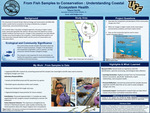
The University of Central Florida's Marine Ecology and Conservation Lab (MECLAB) studies coastal marine ecosystems, focusing on biodiversity, ecological relationships, and environmental change. Through fieldwork and research, the lab works to better understand these ecosystems and support future conservation efforts. My service-learning experience involved supporting research on how fish community composition changes over time in response to increased saltwater flow. Our research takes a top-down ecological approach, focusing on higher trophic levels, particularly gamefish like seatrout. Because these fish depend on certain habitat conditions and food sources, changes in their populations can help indicate changes occurring throughout the ecosystem. Understanding these patterns can help researchers evaluate habitat health and the success of conservation efforts. In the lab, I helped sort, identify, count, measure, and weigh fish collected during field sampling. I typically processed one to two samples per session, contributing to our team's progress toward completing the summer collections, with only one sample remaining. One of the most meaningful parts of my experience was seeing how a bag of preserved fish could become valuable scientific data. Through our work, these samples became organized records of species composition, abundance, length, and mass that can be used to create graphs and study ecological changes over tim. This experience allowed me to apply concepts from my Environmental Science coursework while seeing how my contributions support research that can guide future conservation and habitat restoration efforts.
Keywords
Marine Ecology; Coastal Restoration; Fish Communities; Biodiversity; Ecosystem Health; Service-Learning;
Recommended Citation
Garrido, Allyson and Garrido, Allyson, "From Fish Samples to Conservation: Understanding Coastal Ecosystem Health" (2026). High Impact Practices Student Showcase Fall 2026. 53.
https://stars.library.ucf.edu/hip-2026fall/53
Accessibility Statement
This item was created or digitized prior to April 24, 2027, or is a reproduction of legacy media created before that date. It is preserved in its original, unmodified state specifically for research, reference, or historical recordkeeping. In accordance with the ADA Title II Final Rule, the University Libraries provides accessible versions of archival materials upon request. To request an accommodation for this item, please submit an accessibility request form.