

High Impact Practices Student Showcase Spring 2026
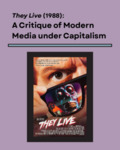
Critique of Modern Media under Capitalism: 'They Live' (1988)
Files
Download Full Text
Course Code
REL
Course Number
3111
Faculty/Instructor
Dr. Cyrus Zargar
Faculty/Instructor Email
Abstract, Summary, or Creative Statement
This project presents an analysis of the 1988 John Carpenter film 'They Live'. I explain that the film responds to the modern world in an original way by presenting a bold critique of the way new technologies and mass media are controlled by capitalist structures.
The film, I argue, stands as a critique of the neoliberal ideologies that were common at the time and continue today through productivity culture on social media, for example. I trace the ideas found in neoliberalism back to the concept of the "protestant work ethic" presented by Max Weber and use Weber's work to analyze the world depicted in 'They Live'. Additionally, I analyze film through a Marxist lens, particularly how it depicts class consciousness and revolutionary thinking.
Furthermore, I use the work of Jean Baudrillard to analyze the role of media and technology in 'They Live'. The dystopian world is one in which people are surrounded by constant stimulation and media, such that everything has lost its meaning and reality is indistinguishable from simulation. The world depicted in the film is meant to mirror our reality, and this critique only becomes more applicable with the expansion of media and technology.
Finally, I examine 'They Live' as a piece of media, one that is limited by its own production, genre, and problematic source material. Still, the film stands out in its bold message and refusal to dilute its themes for the sake of mass appeal.
Keywords
mass media; critical theory; film analysis; technology; neoliberalism; hyperreality
Recommended Citation
McCobb-Pratt, Jade R., "Critique of Modern Media under Capitalism: 'They Live' (1988)" (2026). High Impact Practices Student Showcase Spring 2026. 1.
https://stars.library.ucf.edu/hip-2026spring/1
Accessibility Statement
This item was created or digitized prior to April 24, 2027, or is a reproduction of legacy media created before that date. It is preserved in its original, unmodified state specifically for research, reference, or historical recordkeeping. In accordance with the ADA Title II Final Rule, the University Libraries provides accessible versions of archival materials upon request. To request an accommodation for this item, please submit an accessibility request form.