

High Impact Practices Student Showcase Spring 2026
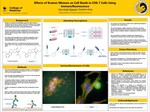
Effects of Kratom Mixture on Cell Death in COS-7 Cells Using Immunofluorescence
Files
Course Code
PCB
Course Number
4529
Faculty/Instructor
Dr. Stephen King
Faculty/Instructor Email
Abstract, Summary, or Creative Statement
The purpose of this project was to visualize the cellular impact of Kratom (Mitragyna speciosa), a supplement commonly utilized for pain management and opioid withdrawal. The project investigated the effects of a 5% Kratom mixture on COS-7 monkey kidney cells. By using immunofluorescence, the cytoskeleton could be observed, and we can determine if Kratom could result in cellular failure.
In the immunofluorescence protocol, the cells were fixed in a methanol based solution to preserve position, while also permeabilizing the membranes with Triton X-100, and applying specific fluorophores. We used indirect staining for Tubulin (Red, Goat anti-mouse 568), direct staining for Actin (Green, Actin-488), and the DNA (Blue, DAPI) counterstain to visualize parts of the cell. These techniques allowed for high resolution imaging of the cytoskeleton under fluorescent microscopy.
The key thing from this research was the cytoskeleton collapsing due to Kratom. Unlike the control cells, which had organized filaments and active mitosis, the Kratom cells showed unorganized and fragmented protein networks. This shows that there are many aspects that play a role in cell life, while also exploring how certain chemicals can drastically alter cell health.
Keywords
Immunofluorescence; kratom; cell death; COS 7 cells;
Recommended Citation
Nguyen, Hoa A., "Effects of Kratom Mixture on Cell Death in COS-7 Cells Using Immunofluorescence" (2026). High Impact Practices Student Showcase Spring 2026. 11.
https://stars.library.ucf.edu/hip-2026spring/11
Accessibility Statement
This item was created or digitized prior to April 24, 2027, or is a reproduction of legacy media created before that date. It is preserved in its original, unmodified state specifically for research, reference, or historical recordkeeping. In accordance with the ADA Title II Final Rule, the University Libraries provides accessible versions of archival materials upon request. To request an accommodation for this item, please submit an accessibility request form.