

High Impact Practices Student Showcase Spring 2026
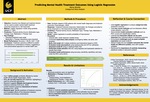
Predicting Mental Health Treatment Outcomes Using Logistic Regression
Files
Download Full Text
Course Code
STA
Course Number
4504
Faculty/Instructor
Mr. Nathaniel Simone
Faculty/Instructor Email
Abstract, Summary, or Creative Statement
This study examines the relationship between lifestyle, demographic, and treatment-related factors and mental health treatment outcomes. Using a synthetic dataset of 500 observations, a logistic regression model was developed to predict whether patients improved following treatment. The response variable was defined as a binary outcome (Improved vs. Not Improved), and predictors included physical activity, medication type, therapy type, and their interaction. Results indicated that individual predictors were generally not significant on their own; however, interaction effects between medication and therapy type were important, suggesting that treatment effectiveness depends on the combination of interventions rather than any single factor. Model performance was weak to modest, with an accuracy of 58.4% and an AUC of 0.6639, indicating limited ability to distinguish between improved and non-improved patients. Overall, the findings highlight the importance of personalized treatment strategies and suggest that mental health outcomes are influenced by complex factors not fully captured in the dataset.
Keywords
Categorical data; logistic regression; treatment outcome; mental health; therapy; medication; interactions; prediction; health
Recommended Citation
Murphy, Macey K., "Predicting Mental Health Treatment Outcomes Using Logistic Regression" (2026). High Impact Practices Student Showcase Spring 2026. 60.
https://stars.library.ucf.edu/hip-2026spring/60
Accessibility Statement
This item was created or digitized prior to April 24, 2027, or is a reproduction of legacy media created before that date. It is preserved in its original, unmodified state specifically for research, reference, or historical recordkeeping. In accordance with the ADA Title II Final Rule, the University Libraries provides accessible versions of archival materials upon request. To request an accommodation for this item, please submit an accessibility request form.