

High Impact Practices Student Showcase Spring 2026
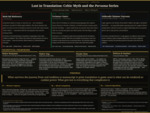
Lost in Translation: Celtic Myth and the Persona Series
Loading...
Files
Download Lost in Translation Transcript.docx (7 KB)
Course Code
ENG
Course Number
6801
Faculty/Instructor
Dr. Louise Kane
Faculty/Instructor Email
louise.kane@ucf.edu
Abstract, Summary, or Creative Statement
This presentation examines how Celtic mythological figures transform when adapted into the Persona and Shin Megami Tensei video game franchises. Comparing medieval Welsh and Irish source texts with their video game incarnations, this project reveals what cultural, narrative, and political specificity disappears in cross-media translation.
The presentation analyzes three case studies. Arianrhod, from the Welsh Mabinogion's Fourth Branch (c. 11th–13th), responds to violated autonomy through legally grounded refusal; Persona reduces her to “Goddess of England,” erasing both her Welsh origin and maternal resistance. Cú Chulainn, from the Irish “Tochmarc Emire” (c. 8th–9th), develops his heroism through Emer's intellectual partnership and Scáthach's martial mentorship; the games retain his battle frenzy (ríastrad) and spear (Gáe Bolg) while systematically removing the women who made both possible. Lugh, from “The Fate of the Children of Tuireann” (c. 13th–15th), engineers a lethal blood-fine through legal technicality; Persona preserves his solar power and unstoppable spear but strips away his calculated coldness.
Drawing on Walter Benjamin (aura and reproduction), Walter Ong (orality and literacy), Wendy Chun (habitual media), and Deleuze and Guattari (rhizomatic networks), the project documents three systematic erasures: female agency is removed, moral complexity is flattened, and cultural specificity is reassigned. The pattern holds across all three figures: what survives the journey into the franchise is what can be rendered as power; what gets lost is everything that complicates it—determined as much by what a medium can represent as by what a culture chooses to carry forward.
Additional Resources
Keywords
Celtic mythology; Persona; Cultural translation; Video game adaptation; Irish mythology; Welsh mythology; Media theory; Cross-media narrative; Postcolonial criticism; Digital folklore
Recommended Citation
Ritchey, Glenn S. III; Restrepo Nazar, Christina; and Duncan, Teddy Jr, "Lost in Translation: Celtic Myth and the Persona Series" (2026). High Impact Practices Student Showcase Spring 2026. 88.
https://stars.library.ucf.edu/hip-2026spring/88
Accessibility Statement
This item was created or digitized prior to April 24, 2026, or is a reproduction of legacy media created before that date. It is preserved in its original, unmodified state specifically for research, reference, or historical recordkeeping. In accordance with the ADA Title II Final Rule, the University Libraries provides accessible versions of archival materials upon request. To request an accommodation for this item, please submit an accessibility request form.